The 10 times table is often described as "trivially easy" — and for good reason. Multiplying any whole number by 10 means just writing that number with a zero added to the end: 3 × 10 = 30, 7 × 10 = 70. That simple rule makes the 10s one of the very first tables kids master, and it becomes the foundation for two important later tricks: the 5-times "half the 10s" method and the 9-times "10-minus-N" method. This page gives you the full 10 times table, the add-a-zero rule, common mistakes to watch for, and a printable worksheet.
The full 10 times table
... with the add-a-zero rule
■ Easy ■ Medium ■ Hard
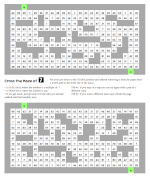
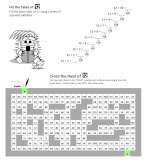
Cross the Maze of ' 10 '
The goal of the game is to traverse the maze.
You have to find a way through the maze by tapping each tile. The SAFE path is going over multiples of ' 10 '. Any number which is not a multiple of ' 10 ' is a trap.
If you step on a trap tile you lose.
If you get from Start to Exit avoiding the traps you WIN.
 Free printable worksheets →
Why the 10 times table is one of the easiest
The 10s have one dominant advantage: they follow the cleanest possible rule in all of arithmetic.
• Just add a zero. For any whole number, multiplying by 10 means writing that number followed by a zero. 3 × 10 = 30. 7 × 10 = 70. 12 × 10 = 120. There's no memorization — the answer is right there in the question, with one small change.
• It reveals how our number system works. The "add a zero" rule works because we count in base 10 — each column represents 10 times the one to its right. Kids who see this pattern get an early glimpse of place value, which pays off for years.
• All products end in 0. Every fact in the 10 times table produces a number ending in 0. An answer ending in any other digit is always wrong — kids can self-check instantly.
Memorization tips for the 10 times table
Three techniques for the 10s. The first one is essentially the whole table:
Just add a zero. For any whole number, 10 × N = "N followed by a zero." This is one of the fastest rules in all of arithmetic.
10 × 3 = 30
10 × 7 = 70
10 × 9 = 90
10 × 4 = 40
Once kids grasp this rule, they can answer any 10-times question instantly. Practice a few dozen times until it becomes reflex.
The two-digit continuation. For multipliers over 10, the rule still works — you just carry the digits.
10 × 11 = 110
10 × 12 = 120
(11 becomes 110; 12 becomes 120)
Same "add a zero" rule, just applied to a two-digit number instead of one. Reassure kids that the rule doesn't change — it works all the way up.
Skip counting by 10s. Chant the sequence — most kids know it from counting money.
10, 20, 30, 40, 50,
60, 70, 80, 90, 100,
110, 120
Reinforces the sequence and prepares kids for two important later tricks: the 5-times table (half of the 10s) and the 9-times table (10 times N, minus N). The 10s carry their weight beyond just their own facts.
Common mistakes to watch for
Adding a zero to the wrong place. Very young kids sometimes write 10 × 3 = 03 instead of 30 — putting the zero at the front instead of the end. Reinforce that the zero goes AFTER the number: "3 with a zero after it is 30, not 03." A common mistake, easy fix.
Doubting the rule for larger multipliers. For 10 × 12, kids sometimes write "120" and then question themselves — "is that right? 12 already has two digits!" Reassure: the rule works the same way regardless. 12 with a zero after it is 120. The rule doesn't break.
Assuming "add a zero" works for other tables. Kids sometimes generalize the rule incorrectly: "5 × 3 = 30?" No — that's the 10-times rule. Only 10s work by adding a zero. Reinforce that this shortcut is specific to the 10 times table, and other tables need their own approaches.
When should kids learn the 10 times table?
The 10 times table is typically taught in 1st or 2nd grade (ages 6-7), often as one of the first three tables (alongside the 2s and 5s). Because the rule is so clean, most children master the 10s within a few days of exposure. The 10s also open the door to place-value understanding, which pays off across all of later arithmetic — so don't skip the concept discussion even though the computation is trivial.
What to practice next
Once the 10s are automatic, they unlock two later tricks. Keep the momentum going:
Ready for more?
For ongoing multiplication practice — and the rest of math fundamentals — Math and Snake is a free game on Google Play (ages 5 to 12). It covers counting, addition, subtraction, times tables, and division, with adjustable difficulty that grows with your child.
