The 2 times table is usually the first "real" times table children learn, and for good reason: it's essentially just doubling, which most kids can already do before they've heard the word "multiplication." But don't underestimate it — the 2s are the foundation that the 4s, 6s, and 8s all build on. Getting the 2s automatic is one of the most valuable things you can do for your child's math future. This page gives you the full 2 times table, tips for building fluency, common mistakes to watch for, and a printable worksheet.
The full 2 times table
... with memorization tricks
■ Easy ■ Medium ■ Hard
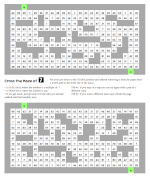
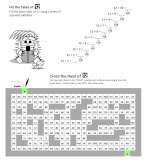
Cross the Maze of ' 2 '
The goal of the game is to traverse the maze.
You have to find a way through the maze by tapping each tile. The SAFE path is going over multiples of ' 2 '. Any number which is not a multiple of ' 2 ' is a trap.
If you step on a trap tile you lose.
If you get from Start to Exit avoiding the traps you WIN.
 Free printable worksheets →
Why the 2 times table is the easiest to learn
The 2s have more built-in advantages than any other table. They're where most math curricula start multiplication for exactly this reason:
• The 2s are just doubling. Kids already know how to double numbers before they know what multiplication is. "Two apples plus two more apples" is intuitive from ordinary counting — the 2 times table just gives that operation a formal name.
• All products are even. Every fact produces an even number: 2, 4, 6, 8, 10, and so on. An odd answer is always wrong — kids can self-check instantly.
• The sequence is the counting-by-2s song. Skip counting by 2s ("2, 4, 6, 8, 10, 12...") is often one of the first counting patterns kids learn, sometimes before school. The 2 times table sequence is already familiar before formal multiplication starts.
Memorization tips for the 2 times table
Most children learn the 2s within days of exposure. Three techniques still help solidify recall:
Skip counting by 2s. The natural rhythm ("2, 4, 6, 8, 10, 12, 14, 16, 18, 20") is instantly familiar to most kids.
2, 4, 6, 8, 10,
12, 14, 16, 18, 20,
22, 24
Once sequential is fluent, move to random-order recall: "what's the 7th number?" (14), "what's the 4th?" (8). Sequential chanting alone isn't fluency.
The doubling frame. Instead of asking "2 × 5 = ?", ask "what's double 5?" — same math, more intuitive for kids who already double.
2 × 3 = double 3 = 6
2 × 7 = double 7 = 14
2 × 9 = double 9 = 18
2 × 12 = double 12 = 24
This framing prepares kids for later doubling tricks — the 4s (double the 2s), 6s (double the 3s), 8s (double the 4s). Establishing "double" as a mental operation early pays off across half the times tables.
Anchor facts and pairs. A few 2-times facts are especially memorable — teach them explicitly.
Easy anchors:
2 × 2 = 4, 2 × 5 = 10,
2 × 10 = 20, 2 × 11 = 22
Double-digit trick:
2 × 11 = 22, 2 × 12 = 24
2 × 5 = 10 is especially useful as a mental pivot: it's the halfway point of the 2 × 10 = 20 fact, and it links the 2s with the 5s (the other easy foundation table).
Common mistakes to watch for
Skipping ahead in the sequence. Kids chanting "2, 4, 6, 8, 10..." sometimes skip a step — jumping from 6 to 10 or from 12 to 16. Random-order recall catches this quickly: if the child can't answer "what's 2 × 4?" without restarting the whole chant, sequential skip counting isn't yet fluency.
Treating 2 × 3 and 3 × 2 as different problems. Same answer, and yes it's commutative — but many kids treat the two versions as separate facts to memorize. Explicitly teach that 2 × 3 and 3 × 2 give the same result. The 2s are the ideal place to introduce commutativity because both sides are so easy to check.
Losing the pattern on larger multipliers. Kids who cruise through 2 × 1 to 2 × 10 sometimes stumble on 2 × 11 or 2 × 12. The pattern still holds (just double the number), but they haven't practiced these specific facts. Include the 11s and 12s in practice — they're often overlooked.
When should kids learn the 2 times table?
Most curricula introduce the 2 times table in 1st or 2nd grade (ages 6-7), often as the very first table taught. It's frequently introduced alongside skip counting, sometimes before formal multiplication vocabulary. Because doubling is so intuitive, many children can answer 2-times questions before they know what "multiplication" means. Get the 2s solid and automatic — everything else depends on it.
What to practice next
Once the 2s feel comfortable, keep the momentum going with these related tables:
Ready for more?
For ongoing multiplication practice — and the rest of math fundamentals — Math and Snake is a free game on Google Play (ages 5 to 12). It covers counting, addition, subtraction, times tables, and division, with adjustable difficulty that grows with your child.
