The 5 times table is one of the easiest to learn — and one of the most important, because it unlocks so many other math skills. Every product ends in either 0 or 5, alternating in a pattern kids notice quickly. The 5s are usually taught right after the 2s and 10s, and most children master them within a week or two of practice. This page gives you the full 5 times table, the alternating pattern trick, common mistakes, and a printable worksheet.
The full 5 times table
... with memorization tricks
■ Easy
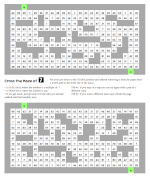
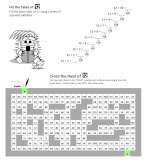
Cross the Maze of ' 5 '
The goal of the game is to traverse the maze.
You have to find a way through the maze by tapping each tile. The SAFE path is going over multiples of ' 5 '. Any number which is not a multiple of ' 5 ' is a trap.
If you step on a trap tile you lose.
If you get from Start to Exit avoiding the traps you WIN.
 Free printable worksheets →
Why the 5 times table is easy
The 5 times table has more built-in patterns than almost any other. Once kids notice the patterns, memorization takes care of itself:
• Products always end in 0 or 5. Every multiple of 5 ends in one of those two digits, alternating perfectly. 5, 10, 15, 20, 25, 30, 35, 40… An answer ending in any other digit is always wrong.
• The clock connection. A clock face is a natural 5 times table — each number represents 5 minutes. Kids who can read a clock have already used the 5s hundreds of times without realizing.
• Half the 10 times table. 5 × N is always exactly half of 10 × N. Since kids learn the 10s trivially ("just add a zero"), they can halve the answer to get the 5s.
Memorization tips for the 5 times table
The 5s often need less structured practice than harder tables — but these techniques help solidify recall:
The alternating pattern. Point out that products alternate: 0, 5, 0, 5, 0, 5. Once kids see it, they can predict any answer's ending.
5 × 1 = 5 5 × 2 = 10
5 × 3 = 15 5 × 4 = 20
5 × 5 = 25 5 × 6 = 30
Odd multipliers give a "5" ending; even multipliers give a "0" ending. This rule is completely reliable.
Skip counting by 5s. Chant "5, 10, 15, 20, 25, 30, 35, 40, 45, 50" out loud. The rhythm is easy — most kids master it within a few sessions.
5, 10, 15, 20, 25, 30, 35, 40, 45, 50, 55, 60
Once the chant is fluent, transition to random-order recall: "what's the 4th number?" (20), "what's the 7th number?" (35), etc.
The half-of-10 trick. If your child already knows the 10 times table, the 5s become instant.
5 × 8: think "10 × 8 = 80, half is 40" → 40
5 × 6: think "10 × 6 = 60, half is 30" → 30
5 × 12: think "10 × 12 = 120, half is 60" → 60
This is especially useful for larger multipliers where skip counting takes too long.
Common mistakes to watch for
Confusing 5 × 6 = 30 with 6 × 5 = 30 — or worse, giving different answers. Some kids treat 5 × 6 and 6 × 5 as if they should have different results. If your child answers one confidently but hesitates on the other, they haven't fully understood commutativity. Use physical objects arranged in rows to make it visible.
Getting the ending pattern reversed. Some kids memorize that products end in 0 or 5, but flip the rule: they expect odd multipliers to end in 0 and even multipliers to end in 5. Reinforce the rule with examples: 5 × 2 = 10 (even × 5 → ends in 0); 5 × 3 = 15 (odd × 5 → ends in 5).
Skip-counting drift on larger multipliers. A child chanting "5, 10, 15, 20, 25, 30, 35, 40…" sometimes loses count around the 7th or 8th step and can't recover. If asked "what's 5 × 9?" they may answer 40 or 50 instead of 45. The fix: practice random-order recall, not just sequential chanting.
When should kids learn the 5 times table?
The 5 times table is typically taught in 2nd grade (ages 7-8), right after the 2s and 10s. It's one of the first "real" multiplication tables kids encounter after mastering counting and simple doubling. Most children are ready for the 5s once they can confidently count by fives to at least 50.
What to practice next
The 5s are a springboard for many other tables. Here's where to go next:
Ready for more?
For ongoing multiplication practice — and the rest of math fundamentals — Math and Snake is a free game on Google Play (ages 5 to 12). It covers counting, addition, subtraction, times tables, and division, with adjustable difficulty that grows with your child.
