The 9 times table looks intimidating — the numbers get large fast, and 9s don't have the rhythmic feel of 5s or 10s. But the 9s are secretly one of the most pattern-rich tables of all. Once your child sees the digit-sum trick, the "one less" pattern, and the 10-minus-N method, the 9s become one of the most satisfying tables to learn. This page gives you the full 9 times table, the classic 9s tricks, common mistakes, and a printable worksheet.
The full 9 times table
... with memorization tricks
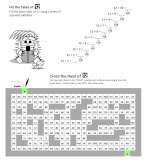
30 - 3 = 27
60 - 6 = 54
70 - 7 = 63
80 - 8 = 72
■ Easy ■ Medium ■ Hard
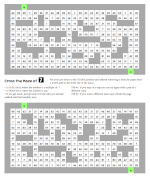
Cross the Maze of ' 9 '
The goal of the game is to traverse the maze.
You have to find a way through the maze by tapping each tile. The SAFE path is going over multiples of ' 9 '. Any number which is not a multiple of ' 9 ' is a trap.
If you step on a trap tile you lose.
If you get from Start to Exit avoiding the traps you WIN.
 Free printable worksheets →
Why the 9 times table has hidden patterns
The 9s have more built-in patterns than almost any other table — probably because 9 is one less than 10, and the 10s are trivially easy:
• The digits of every product sum to 9. Try it: 18 → 1+8 = 9, 27 → 2+7 = 9, 36 → 3+6 = 9. Every single product in the 9 times table (up to 9 × 10) has digits that sum to 9. Kids can use this as a self-check on any answer.
• The "one less" pattern. The tens digit of 9 × N is always one less than N: 9 × 4 = 36, 9 × 7 = 63, 9 × 8 = 72. Combined with the digit-sum rule, kids can reconstruct any 9-times fact from scratch.
• 9 × N = 10 × N − N. Since multiplying by 10 is trivial (just add a zero), subtract N to get 9 × N. Example: 9 × 7 = 70 − 7 = 63. This is the fastest mental method.
Memorization tips for the 9 times table
The 9s reward pattern recognition more than raw memorization. Three techniques worth teaching in order:
The 10-minus-N trick. By far the fastest mental method — and the one that generalizes to bigger numbers later.
9 × 3: think "10 × 3 = 30, minus 3 = 27"
9 × 6: think "10 × 6 = 60, minus 6 = 54"
9 × 7: think "10 × 7 = 70, minus 7 = 63"
9 × 8: think "10 × 8 = 80, minus 8 = 72"
Since kids automate multiplying by 10 early, this method makes any 9-times fact accessible. Teach it first.
The finger trick. A classic — actually useful, not just a party trick. Works for 9 × 1 through 9 × 10.
Hold up 10 fingers. To find 9 × N, fold down finger #N (counting from the left).
Fingers left of the folded one = the tens digit.
Fingers right of the folded one = the ones digit.
Example — 9 × 4: fold finger 4, count 3 fingers on the left and 6 on the right → 36.
Feels like magic to kids the first few times, and it locks in the "one less" pattern through physical practice.
Digit-sum verification. Not a way to compute an answer — a way to check one.
Guess 9 × 6 = 45? Check: 4 + 5 = 9 ✓ (right)
Guess 9 × 6 = 56? Check: 5 + 6 = 11 ✗ (wrong)
Guess 9 × 8 = 72? Check: 7 + 2 = 9 ✓ (right)
Teaches self-checking, a habit that carries into all math. If the digit sum isn't 9, the answer is wrong. Simple rule, powerful safety net.
Common mistakes to watch for
Reversing digits: 9 × 6 = 45 vs 54. Both digits look right, but placed in the wrong order. Common when kids know the digits are 4 and 5 but forget which comes first. The "one less" pattern fixes this: for 9 × 6, the tens digit is 6 − 1 = 5, so the answer is 54, not 45.
Skipping the double-check step. Kids trust their memory more than they should, guess wrong, and don't verify with the digit-sum trick. Build the checking habit as part of the answer — "9 × 8 = 72, and 7 + 2 = 9, so it works."
Fumbling 9 × 11 = 99 and 9 × 12 = 108. The patterns break at 11 (99 has digits summing to 18, not 9) and 12 (108 is a three-digit answer). These two facts need to be memorized separately. Teach 9 × 11 = 99 as the "double 9" fact, and 9 × 12 = 108 as an anchor to remember directly.
When should kids learn the 9 times table?
Most curricula introduce the 9 times table in 3rd grade (ages 8-9), after the easier tables. Because the 9s have so many patterns, they're often introduced right before or after the 7s and 8s — sometimes taught as a "fun" reward table because the tricks are genuinely delightful. If your child hasn't mastered the 10 times table, delay the 9s: the 10-minus-N trick depends on rock-solid 10s.
What to practice next
Once the 9s feel comfortable, keep the momentum going with these related tables:
Ready for more?
For ongoing multiplication practice — and the rest of math fundamentals — Math and Snake is a free game on Google Play (ages 5 to 12). It covers counting, addition, subtraction, times tables, and division, with adjustable difficulty that grows with your child.
