The 11 times table is famous for one of the most fun tricks in all the times tables: for single-digit multipliers, you just repeat the digit. 11 × 3 = 33. 11 × 7 = 77. 11 × 9 = 99. The pattern feels almost too easy to be true. But the trick breaks cleanly at 11 × 10 and takes a new form at 11 × 11 and 11 × 12 — worth knowing where it stops working and what to do instead. This page gives you the full 11 times table, the double-digit trick, the paired-digit-add pattern for the higher multipliers, common mistakes, and a printable worksheet.
The full 11 times table
... with the double-digit trick
■ Easy ■ Medium ■ Hard
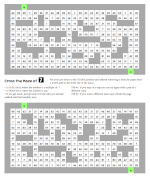
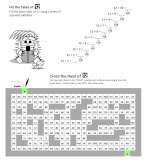
Cross the Maze of ' 11 '
The goal of the game is to traverse the maze.
You have to find a way through the maze by tapping each tile. The SAFE path is going over multiples of ' 11 '. Any number which is not a multiple of ' 11 ' is a trap.
If you step on a trap tile you lose.
If you get from Start to Exit avoiding the traps you WIN.
 Free printable worksheets →
Why the 11 times table has a memorable pattern
The 11s have the friendliest single-digit trick of any table — but the pattern shifts at higher multipliers. Here's what makes each part work:
• The double-digit rule. For any single-digit multiplier (1 through 9), the answer is just that digit repeated: 11 × 4 = 44, 11 × 7 = 77, 11 × 9 = 99. It's the cleanest visual pattern in all the times tables and kids find it genuinely delightful.
• The rule breaks cleanly at 11 × 10. The answer is 110 (following the 10s rule). This isn't a bug — it's actually consistent with how our number system works. The 11 × 10 fact just needs to be memorized as an exception.
• The paired-digit-add pattern for 11 × 11 and 11 × 12. For these two, take the digits of the multiplier and put their SUM between them: 11 × 11 → 1+1=2, so 121. 11 × 12 → 1+2=3, so 132. Once kids see this pattern, all three "advanced" 11s become predictable.
Memorization tips for the 11 times table
Three techniques cover the whole 11 times table cleanly:
The double-digit trick. For single-digit multipliers (1 through 9), the answer is just that digit doubled.
11 × 3 = 33
11 × 5 = 55
11 × 7 = 77
11 × 9 = 99
The most fun trick in all the times tables. Kids love it. Practice until it's reflex — nine facts, one rule, one visual pattern that's impossible to forget.
11 × 10 follows the 10s rule. Just add a zero — this fact is an exception to the double-digit trick.
11 × 10 = 110
(Not 1010 — the double-digit trick stops at 11 × 9)
The double-digit trick would predict "1010," but the actual answer is 110. This is where the pattern breaks. Memorize 11 × 10 = 110 as its own fact, then the rule resumes with a new pattern below.
The paired-digit-add pattern for 11 × 11 and 11 × 12. Take the digits of the multiplier and insert their sum between them.
11 × 11: digits of 11 are 1 and 1
→ 1 + 1 = 2 → answer is 121 = 121
11 × 12: digits of 12 are 1 and 2
→ 1 + 2 = 3 → answer is 132 = 132
This trick works cleanly up to 11 × 18 before the digit-sum needs to carry. For our range (up to 12), it's reliable and just as satisfying as the double-digit trick.
Common mistakes to watch for
Applying the double-digit rule to 11 × 10. Kids who love the digit-doubling trick sometimes write 11 × 10 = 1010 instead of 110. The rule stops working at 10 because "10" has two digits and can't just be repeated as a single digit would be. Reinforce that the double-digit trick works for single-digit multipliers only.
Getting the paired-digit-add pattern wrong. For 11 × 12, kids sometimes write "1212" (repeating both digits) instead of 132 (inserting the sum). The pattern requires ADDING the digits, not concatenating them. Practice with 11 × 11 first (both digits are 1, so the sum is 2 and the answer is 121) before moving to 11 × 12.
Assuming similar "repeat" tricks work for other tables. Some kids generalize the trick incorrectly: "Does 22 × 3 = 66 by the same trick?" (Yes, but for different mathematical reasons — 22 × 3 = 2 × 3 with a 2 tacked on because 22 = 2 × 11.) Explain that the "digit repeats" trick is specific to 11 and doesn't extend to arbitrary multipliers.
When should kids learn the 11 times table?
The 11 times table is typically introduced in 3rd or 4th grade (ages 8-10), usually after the harder single-digit tables (7s, 8s, 9s) since the 11s are so much easier by comparison. Some curricula pair the 11s and 12s together as "extension" tables beyond the standard 1-10. Because the double-digit pattern is so satisfying, the 11s often feel like a well-earned reward after grinding through the harder tables.
What to practice next
Once the 11s feel comfortable, keep the momentum going with these related tables:
Ready for more?
For ongoing multiplication practice — and the rest of math fundamentals — Math and Snake is a free game on Google Play (ages 5 to 12). It covers counting, addition, subtraction, times tables, and division, with adjustable difficulty that grows with your child.
