The 12 times table is often the final table kids learn in standard curricula. The numbers get large (up to 144), and there's no dominant pattern like the 9s' digit-sum trick or the 11s' double-digit repeat. But the 12s have their own reliable technique: the 10-plus-2 chunking method (12 × N = 10 × N + 2 × N), which turns any 12-times fact into two easy sub-problems. This page gives you the full 12 times table, the chunking method, common mistakes, and a printable worksheet.
The full 12 times table
... with chunking tricks
■ Easy ■ Medium ■ Hard
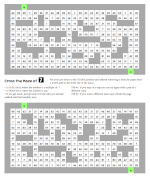
Cross the Maze of ' 12 '
The goal of the game is to traverse the maze.
You have to find a way through the maze by tapping each tile. The SAFE path is going over multiples of ' 12 '. Any number which is not a multiple of ' 12 ' is a trap.
If you step on a trap tile you lose.
If you get from Start to Exit avoiding the traps you WIN.
 Free printable worksheets →
What makes the 12 times table manageable
The 12s look intimidating at first — the numbers get large fast. But three built-in advantages make them more approachable than they appear:
• 12 = 10 + 2. Since the 10s and 2s are both trivially easy, any 12-times fact can be broken into two easy sub-facts. This is the master technique for the 12s — the one method that unlocks the whole table.
• All products are even. Because 12 is even, every fact produces an even number. An odd answer is always wrong — kids can self-check instantly.
• Two great anchor facts. 12 × 10 = 120 (via the 10s rule) and 12 × 12 = 144 (a memorable square number) sit at natural reference points. Combined with 12 × 5 = 60 (half of 120), kids have three solid anchors to reason from.
Memorization tips for the 12 times table
Three techniques for building 12-times fluency:
The 10-plus-2 chunking method. By far the most useful technique. Every 12-times fact becomes a 10-times fact plus a 2-times fact.
12 × 6: think "10 × 6 = 60, plus 2 × 6 = 12, total 72"
12 × 7: think "10 × 7 = 70, plus 2 × 7 = 14, total 84"
12 × 8: think "10 × 8 = 80, plus 2 × 8 = 16, total 96"
12 × 9: think "10 × 9 = 90, plus 2 × 9 = 18, total 108"
Every 12-times fact becomes two easy sub-facts. Both are easy, so the sum is easy. This method works forever and generalizes to bigger multiplications later in school.
Double the 6 times table. Since 12 = 6 × 2, any 12-times fact is double the equivalent 6-times fact.
12 × 4: think "6 × 4 = 24, doubled = 48"
12 × 7: think "6 × 7 = 42, doubled = 84"
12 × 8: think "6 × 8 = 48, doubled = 96"
Alternative to the 10-plus-2 method for kids who prefer doubling to adding. Works only if the 6s are solid — check first before relying on this path.
Anchor facts. A few 12-times facts are especially memorable — use them as reference points.
Key anchors:
12 × 5 = 60, 12 × 10 = 120,
12 × 12 = 144
12 × 12 = 144 is one of the most memorable "square" facts in the whole times tables. Kids often remember it years later because it's the classic "twelve dozen" fact — 144 is a "gross" in traditional counting.
Common mistakes to watch for
Confusing 12 × 7 = 84 with 12 × 8 = 96. Both facts sit in the same numerical neighborhood, and both are hard to compute directly. Kids sometimes swap them. The 10-plus-2 method catches this: 12 × 7 = 70 + 14 = 84 (not 96). Use chunking as a self-check.
Chunking errors — forgetting the second sub-fact. A child computing 12 × 6 might correctly get "10 × 6 = 60" but then forget to add "2 × 6 = 12." The answer becomes 60 instead of 72. Practice saying both sub-facts out loud until the two-step process becomes automatic — always both parts, always the sum.
Mixing up the 12 times table with the 11 times table. Since 11 and 12 are both taught late and both have their own patterns, kids sometimes confuse them: 11 × 3 = 33 (double-digit trick) vs 12 × 3 = 36 (chunking). Practice them separately, not back-to-back, until each is solid on its own before mixing.
When should kids learn the 12 times table?
The 12 times table is typically taught in 3rd or 4th grade (ages 9-10), usually as the final table in the standard 1-12 curriculum. Historically, the 12s were emphasized because pre-decimal Britain used base-12 for measurements (12 inches to a foot, 12 pence to a shilling). Today the primary reason is that fluency up to 12 covers most everyday multiplication situations kids will encounter for years — including telling time, working with dozens, and reading a clock face.
What to practice next
You've reached the end of the standard times tables. Once the 12s feel comfortable, revisit any table that still feels shaky:
Ready for more?
For ongoing multiplication practice — and the rest of math fundamentals — Math and Snake is a free game on Google Play (ages 5 to 12). It covers counting, addition, subtraction, times tables, and division, with adjustable difficulty that grows with your child.
