The 6 times table sits right in the middle of the difficulty spectrum — not as easy as the 2s and 5s, but nowhere near as hard as the 7s. It has one enormous advantage most kids don't hear about: the 6s are exactly double the 3s. If your child knows the 3 times table, the 6s become dramatically easier. This page gives you the full 6 times table, the doubling trick and other memorization tips, common mistakes, and a printable worksheet.
The full 6 times table
... with memorization tricks
■ Easy ■ Medium ■ Hard
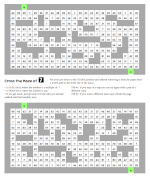
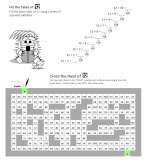
Cross the Maze of ' 6 '
The goal of the game is to traverse the maze.
You have to find a way through the maze by tapping each tile. The SAFE path is going over multiples of ' 6 '. Any number which is not a multiple of ' 6 ' is a trap.
If you step on a trap tile you lose.
If you get from Start to Exit avoiding the traps you WIN.
 Free printable worksheets →
What makes the 6 times table easier than it looks
The 6 times table has three built-in advantages that kids don't always notice:
• The 6s are exactly double the 3s. If your child knows 3 × 7 = 21, then 6 × 7 = 42 (just double it). This is the single most useful shortcut for the 6s.
• All products are even. Every fact in the 6 times table produces an even number. An odd answer is always wrong. Kids can catch their own mistakes just from that.
• The 6 × even-number facts have a curious pattern. When you multiply 6 by an even number, the answer ends in the same digit as the other number: 6 × 4 = 24 (ends in 4), 6 × 6 = 36 (ends in 6), 6 × 8 = 48 (ends in 8). Kids find this delightful.
Memorization tips for the 6 times table
Three approaches that work well for most kids:
The doubling trick. If the 3 times table is solid, use it as the launching pad.
6 × 4: think "3 × 4 = 12, then double it" → 24
6 × 7: think "3 × 7 = 21, then double it" → 42
6 × 8: think "3 × 8 = 24, then double it" → 48
6 × 9: think "3 × 9 = 27, then double it" → 54
This is the fastest reliable method. Make sure the 3s are automated before leaning on this heavily.
The 5-plus-1 method. Since the 5 times table is easy, break the 6s into "5 groups plus 1 more group."
6 × 7: think "5 × 7 = 35, plus one more 7" → 35 + 7 = 42
6 × 8: think "5 × 8 = 40, plus one more 8" → 40 + 8 = 48
6 × 9: think "5 × 9 = 45, plus one more 9" → 45 + 9 = 54
This method is great for kids who know the 5s well but are still shaky on the 3s.
Anchor facts and the even-times trick. Some 6-times facts are memorable on their own.
Easy anchors: 6 × 1 = 6 · 6 × 5 = 30 · 6 × 10 = 60 · 6 × 6 = 36
Even-times pattern: 6 × 4 = 24 · 6 × 6 = 36 · 6 × 8 = 48
The 6 × 6 = 36 fact especially — it's a square number and easy to remember. Use it as a mid-point anchor.
Common mistakes to watch for
Confusing 6 × 7 = 42 with 7 × 6 = 42. Same answer, but kids don't always trust that. If your child hesitates on one direction but confidently answers the other, they haven't fully internalized that multiplication is commutative. Use arrays (6 rows of 7 dots vs 7 rows of 6 dots — same rectangle) to make it visible.
Mixing 6 × 4 = 24 with 4 × 6 = 24 and 8 × 3 = 24. Three different multiplication facts, one shared answer. Kids sometimes memorize the answer without linking it to the right question. If your child answers 24 quickly but can't tell you which fact produced it, they're pattern-matching without understanding.
Doubling errors from shaky 3 times tables. The doubling trick fails if the 3s aren't solid. A child who thinks 3 × 8 = 21 (wrong — it's 24) will get 6 × 8 = 42 (also wrong). If your child struggles with the 6s using the doubling method, back up and check the 3s.
When should kids learn the 6 times table?
Most curricula introduce the 6 times table in 3rd grade (ages 8-9), right after the easier tables (2s, 5s, 10s, 3s, 4s). It's usually taught alongside or just before the 7s and 8s. If your child hasn't yet mastered the 3s, delay the 6s and go back — the 6s will feel much easier once the 3s are automatic.
What to practice next
Once the 6s feel comfortable, keep the momentum going with these related tables:
Ready for more?
For ongoing multiplication practice — and the rest of math fundamentals — Math and Snake is a free game on Google Play (ages 5 to 12). It covers counting, addition, subtraction, times tables, and division, with adjustable difficulty that grows with your child.
