The 4 times table is one of the easier tables to learn — and one of the most useful, because it unlocks the 8 times table. If your child knows the 2s (which almost every child does early), the 4 times table is just "double the 2s again." This page gives you the full 4 times table, the doubling technique, common mistakes, and a printable worksheet.
The full 4 times table
... with memorization tricks
■ Easy ■ Medium ■ Hard
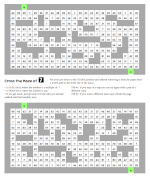
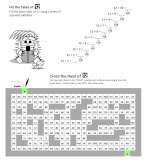
Cross the Maze of ' 4 '
The goal of the game is to traverse the maze.
You have to find a way through the maze by tapping each tile. The SAFE path is going over multiples of ' 4 '. Any number which is not a multiple of ' 4 ' is a trap.
If you step on a trap tile you lose.
If you get from Start to Exit avoiding the traps you WIN.
 Free printable worksheets →
Why the 4 times table is one of the easier ones
The 4s have three built-in advantages that make them one of the friendlier tables to teach:
• The 4s are exactly double the 2s. If your child knows 2 × 7 = 14, then 4 × 7 = 28 (just double it). Since the 2s are usually the first table kids master, this shortcut is immediately available.
• All products are even. Because 4 is even, every fact produces an even number. Odd answers are always wrong — kids can self-check.
• The last-digit cycle. The final digits of 4 × 1 through 4 × 10 follow a repeating cycle: 4, 8, 2, 6, 0, 4, 8, 2, 6, 0. Kids who notice the cycle can double-check their answers.
Memorization tips for the 4 times table
Three techniques that build 4-times fluency:
The doubling trick. If the 2 times table is solid, use it as the launching pad.
4 × 6: think "2 × 6 = 12, then double it" → 24
4 × 7: think "2 × 7 = 14, then double it" → 28
4 × 8: think "2 × 8 = 16, then double it" → 32
4 × 9: think "2 × 9 = 18, then double it" → 36
Fastest reliable method. Make sure the 2s are automatic before leaning on this heavily.
Double, then double again. For kids who struggle with "double a two-digit number," another path: to multiply by 4, just double the number twice.
4 × 6: double 6 → 12, double again → 24
4 × 7: double 7 → 14, double again → 28
4 × 9: double 9 → 18, double again → 36
Slower than the 2×N method but works when doubling numbers over 10 is still shaky. Two small doublings often feel easier than one large one.
Anchor facts. Some 4-times facts stick naturally — use them as reference points.
Easy anchors:
4 × 1 = 4, 4 × 2 = 8,
4 × 5 = 20, 4 × 10 = 40,
4 × 4 = 16
4 × 4 = 16 is a memorable square number, sitting right in the middle of the table. Use it as a pivot to reason about neighboring facts.
Common mistakes to watch for
Confusing 4 × 6 = 24 with 6 × 4 = 24 and 3 × 8 = 24. Same answer, three different multiplication facts. Kids don't always link the answer to the specific question. Use arrays (4 rows of 6 dots vs 6 rows of 4 dots) to make commutativity visible.
Doubling errors on larger numbers. A child computing 4 × 8 as "2 × 8 = 16, double is 30" (wrong — it's 32) has a doubling problem, not a 4-times problem. If doubling two-digit numbers is shaky, back up and practice doubling first.
Mixing 4 × 7 = 28 with 4 × 8 = 32 and 4 × 9 = 36. These three facts end in different digits but sit close together numerically. Kids grab the wrong nearby answer. Over-practice each anchor individually until it becomes automatic.
When should kids learn the 4 times table?
Most curricula introduce the 4 times table in 2nd or 3rd grade (ages 7-8), after the 2s, 5s, and 10s. It builds naturally on the 2s, and mastering it unlocks the 8 times table later. If your child hasn't fully automated the 2s yet, delay the 4s and go back — the doubling trick only works when the 2s are solid.
What to practice next
Once the 4s feel comfortable, keep the momentum going with these related tables:
Ready for more?
For ongoing multiplication practice — and the rest of math fundamentals — Math and Snake is a free game on Google Play (ages 5 to 12). It covers counting, addition, subtraction, times tables, and division, with adjustable difficulty that grows with your child.
