The 3 times table is one of the most important tables for kids to master — not because it's the hardest, but because so many other tables build on it. If your child knows the 3s solidly, the 6 times table becomes "just double the 3s" and the 9 times table has patterns that click into place. This page gives you the full 3 times table, skip-counting techniques, the digit-sum trick, common mistakes, and a printable worksheet.
The full 3 times table
... with memorization tricks
■ Easy ■ Medium ■ Hard
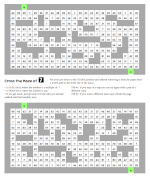
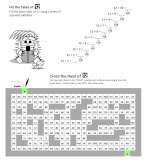
Cross the Maze of ' 3 '
The goal of the game is to traverse the maze.
You have to find a way through the maze by tapping each tile. The SAFE path is going over multiples of ' 3 '. Any number which is not a multiple of ' 3 ' is a trap.
If you step on a trap tile you lose.
If you get from Start to Exit avoiding the traps you WIN.
 Free printable worksheets →
What makes the 3 times table trickier than it looks
The 3s look easy on paper — small numbers, quick to say. But the 3 times table is where many kids first hit real memorization work:
• No rhythmic pattern like the 2s or 5s. The 2s go "2, 4, 6, 8..." with even endings; the 5s alternate 0 and 5. The 3s ("3, 6, 9, 12, 15, 18, 21...") don't chant as smoothly, so the rhythm doesn't do the work for you.
• Products cycle through every digit ending. Unlike the 2s (always end in even) or 5s (always 0 or 5), the 3-times products end in every possible digit. There's no last-digit shortcut for self-checking.
• This is often the first "real" memorization table. After the 2s, 5s, and 10s (which have obvious tricks), the 3s are where kids realize they'll actually need to memorize some facts. Set expectations for both parent and child.
Memorization tips for the 3 times table
Three techniques that work well for building 3-times fluency:
Skip counting by 3s. Chant the sequence out loud until it flows: "3, 6, 9, 12, 15, 18, 21, 24, 27, 30." Even without an obvious rhythm, repetition builds recall.
3, 6, 9, 12, 15,
18, 21, 24, 27, 30,
33, 36
Once sequential is fluent, move to random-order recall: "what's the 7th number?" (21), "what's the 4th?" (12). Sequential chanting alone isn't fluency.
The digit-sum trick. Every product in the 3 times table has digits that sum to a multiple of 3.
12 → 1 + 2 = 3 ✓
18 → 1 + 8 = 9 ✓
27 → 2 + 7 = 9 ✓
36 → 3 + 6 = 9 ✓
If your child guesses an answer, they can check it: sum the digits. If not a multiple of 3, wrong answer. Teaches self-checking, a habit that carries into all math.
Anchor facts. Some 3-times facts are naturally memorable — build from those first.
Easy anchors:
3 × 1 = 3, 3 × 3 = 9,
3 × 5 = 15, 3 × 10 = 30
3 × 3 = 9 is especially useful — a square number kids remember, right in the middle of the table. Use it as a pivot to work outward toward 3 × 2 and 3 × 4.
Common mistakes to watch for
Skip-counting drift after the first few. Kids chant "3, 6, 9, 12, 15..." then lose track. If asked out of order ("what's 3 × 7?"), they restart the chant from 1 every time. Practice random-order recall, not just sequential chanting.
Confusing 3 × 4 = 12 with 4 × 3 = 12 and 2 × 6 = 12. Same answer, three different facts. Kids grab whichever they memorized last. Use arrays (3 rows of 4 dots vs 4 rows of 3 dots — same rectangle, rotated) to make commutativity visible.
Off-by-one skip errors. A child computing 3 × 6 by counting "3, 6, 9, 12, 15, 18" sometimes stops one step early (15) or late (21). The digit-sum check catches this: 15 → 1+5 = 6 (not a multiple of 3, wrong); 18 → 1+8 = 9 ✓.
When should kids learn the 3 times table?
Most curricula introduce the 3 times table in 2nd or 3rd grade (ages 7-8), after the 2s, 10s, and 5s. It's usually the first "real" memorization table after the easy patterns. Getting the 3s solid pays off enormously — the 6s, 9s, and 12s all build directly on the 3s.
What to practice next
Once the 3s feel comfortable, keep the momentum going with these related tables:
Ready for more?
For ongoing multiplication practice — and the rest of math fundamentals — Math and Snake is a free game on Google Play (ages 5 to 12). It covers counting, addition, subtraction, times tables, and division, with adjustable difficulty that grows with your child.
