The 8 times table ranks just behind the 7s as one of the hardest times tables for kids to memorize. But there's a shortcut most curricula don't emphasize enough: the 8s are just double the 4s. If your child knows the 4 times table, the 8 times table becomes dramatically easier. This page gives you the full 8 times table, the doubling trick and other memorization tips, common mistakes, and a printable worksheet.
The full 8 times table
... with memorization tricks
■ Easy ■ Medium ■ Hard
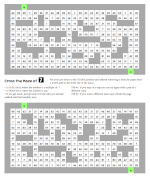
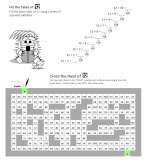
Cross the Maze of ' 8 '
The goal of the game is to traverse the maze.
You have to find a way through the maze by tapping each tile. The SAFE path is going over multiples of ' 8 '. Any number which is not a multiple of ' 8 ' is a trap.
If you step on a trap tile you lose.
If you get from Start to Exit avoiding the traps you WIN.
 Free printable worksheets →
Why the 8 times table is hard (and where it's actually easy)
The 8s share some of the same difficulties as the 7s — the products don't have obvious visual patterns, and the numbers get large fast. But the 8s have one enormous advantage the 7s don't: they build directly on tables kids usually already know.
• The 8s are exactly double the 4s. If your child knows 4 × 6 = 24, then 8 × 6 = 48 (just double it). This makes the 8 times table potentially the easiest "hard" table, if you teach the doubling relationship explicitly.
• All products are even. Because 8 is even, every fact in the 8 times table produces an even number. Kids who write down an odd number for an 8-times answer know instantly they've made a mistake.
• The last-digit pattern. The final digits of 8 × 1 through 8 × 10 follow a cycle: 8, 6, 4, 2, 0, 8, 6, 4, 2, 0. Once kids notice, they can double-check their answers.
Memorization tips for the 8 times table
Three approaches, in order of effectiveness for most kids:
The doubling trick. If your child knows the 4 times table, the 8 times table is one doubling step away.
8 × 3: think "4 × 3 = 12, then double it" → 24
8 × 6: think "4 × 6 = 24, then double it" → 48
8 × 7: think "4 × 7 = 28, then double it" → 56
8 × 9: think "4 × 9 = 36, then double it" → 72
This is by far the most efficient method. Get the 4s solid first, then use them as the launch pad for the 8s.
Anchor facts. Some 8-times facts are easier to remember directly. Get these first and work outward.
Easy anchors:
8 × 1 = 8, 8 × 2 = 16,
8 × 5 = 40, 8 × 10 = 80,
8 × 8 = 64
Kids often remember 8 × 8 = 64 because it's a memorable "square number" — and it sits right in the middle of the harder facts.
Chunking for the hard middle. The trickiest facts (8 × 6, 8 × 7, 8 × 9) can be broken into easier pieces if doubling doesn't stick.
8 × 7 = (8 × 5) + (8 × 2) = 40 + 16 = 56
8 × 9 = (8 × 10) − 8 = 80 − 8 = 72
The 8 × 9 trick (multiply by 10, then subtract 8) is especially handy — kids automate multiplying by 10 early, so it's a fast mental path.
Common mistakes to watch for
Confusing 8 × 7 = 56 with 7 × 8 = 56. This isn't actually a mistake — but it becomes one when kids know one direction and don't trust the other. Some children who confidently answer 7 × 8 will hesitate on 8 × 7, as if it's a different problem. Show them arrays until commutativity clicks.
Mixing 8 × 8 = 64 with 8 × 7 = 56 or 9 × 7 = 63. The products 56, 63, 64 all live in the same neighborhood and share digits. Kids grab the wrong nearby answer. The fix: over-practice 8 × 8 specifically until it becomes an automatic anchor.
Doubling errors on hard 4-times facts. The doubling trick only works if the 4 times table is solid. A child who guesses at 4 × 7 = 32 (wrong — it's 28) will get 8 × 7 = 64 (also wrong). If your child is struggling with the 8s using the doubling method, back up and verify the 4s are actually automated.
When should kids learn the 8 times table?
Most curricula introduce the 8 times table in 3rd grade (ages 8-9), typically after the 4 times table (which the 8s build on). If your child is being taught the 8s but hasn't mastered the 4s, that's the underlying problem — go back to the 4s and the 8s become much easier.
What to practice next
Once the 8s feel comfortable, keep the momentum going with these related tables:
Ready for more?
For ongoing multiplication practice — and the rest of math fundamentals — Math and Snake is a free game on Google Play (ages 5 to 12). It covers counting, addition, subtraction, times tables, and division, with adjustable difficulty that grows with your child.
