The 7 times table is widely considered the hardest multiplication table for kids to learn. Unlike the 2s, 5s, or 10s — which have obvious patterns — the 7 times table has no rhythmic shortcut. If your child is stuck on the 7s, they're in good company. This page gives you the full 7 times table, memorization tricks specific to it, the common mistakes kids make, and a printable worksheet you can use tonight.
The full 7 times table
... with memorization tricks
■ Easy ■ Medium ■ Hard
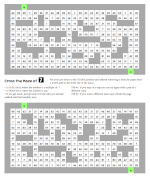
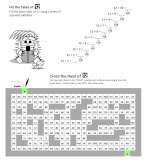
Cross the Maze of ' 7 '
The goal of the game is to traverse the maze.
You have to find a way through the maze by tapping each tile. The SAFE path is going over multiples of ' 7 '. Any number which is not a multiple of ' 7 ' is a trap.
If you step on a trap tile you lose.
If you get from Start to Exit avoiding the traps you WIN.
 Free printable worksheets →
Why the 7 times table is hard
• No rhythmic pattern. The 2s, 5s, and 10s have musical, easy-to-chant rhythms. The 7s don't. Try skip-counting "7, 14, 21, 28, 35, 42, 49…" out loud — it doesn't flow.
• No digit shortcut. The 9s have the digit-sum trick (products' digits always sum to 9). The 5s always end in 0 or 5. The 7s have none of these visual patterns.
• 7 is prime number. The 4s are double the 2s, the 8s are double the 4s, the 6s are double the 3s — most tables build on easier ones. 7 doesn't. It stands alone.
Memorization tips for the 7 times table
Since the 7s lack the shortcuts of other tables, you need to lean harder on general memorization techniques. Three that work especially well:
Start with the anchor facts. A few 7-times facts are easier than the rest. Get these solid first, and use them to work out the harder ones.
Easy anchors:
7 × 1 = 7, 7 × 2 = 14
7 × 5 = 35, 7 × 10 = 70,
7 × 7 = 49
Kids often know 7 × 7 = 49 already — it's a memorable "square number." Build from there.
Use chunking for the hard ones. Any 7-times fact can be broken into a 5-times fact plus a 2-times fact.
7 × 8 = (5 × 8) + (2 × 8) = 40 + 16 = 56
7 × 6 = (5 × 6) + (2 × 6) = 30 + 12 = 42
7 × 9 = (5 × 9) + (2 × 9) = 45 + 18 = 63
Slower than pure recall, but it always works — and after enough chunking, the answer eventually sticks as a memorized fact.
Use commutativity to your advantage. If your child already knows the 3s, 4s, and 5s, they already know half the 7 times table — just from the other direction.
Know 3 × 7 = 21? Then 7 × 3 = 21.
Know 4 × 7 = 28? Then 7 × 4 = 28.
Know 5 × 7 = 35? Then 7 × 5 = 35.
Many kids don't intuitively trust that 3 × 7 and 7 × 3 give the same answer. Show them arrays (3 rows of 7 dots vs 7 rows of 3 dots — same rectangle, rotated) until they believe it.
Common mistakes to watch for
Since the 7s lack the shortcuts of other tables, you need to lean harder on general memorization techniques. Three that work especially well:
Confusing 7 × 8 with nearby facts. 7 × 8 = 56 lives right next to 8 × 8 = 64, 7 × 7 = 49, and 6 × 8 = 48 — all in the same numerical neighborhood. Kids frequently guess one when they mean another. If your child answers with confidence but wrong, they often just grabbed the wrong nearby fact.
Skip-counting errors around 35. Kids trying to skip-count the 7s often lose track at 35 → 42 (the jump from a "5-ending" number to a "2-ending" number breaks the pattern their brain was tracking). If your child recites "7, 14, 21, 28, 35…" then stalls, they're not stuck — they've just hit the natural rhythm-break point.
Assuming 7 × 6 must be an even number ending in a specific digit. Because the 6 times table always ends in an even digit (6, 2, 8, 4, 0), some kids expect 7 × 6 to follow the same rule from the 7-side. The answer is 42 — which does end in an even digit — but the reasoning is coincidental, not a rule. Don't let kids over-generalize.
When should kids learn the 7 times table?
Most curricula introduce the 7 times table in 3rd grade (ages 8-9), after kids have mastered the 2s, 5s, 10s, and the easier tables. If your child is younger and struggling with the 7s, that might be why — the 7s are typically the last "regular" table taught, on purpose. If they haven't yet mastered the 2s, 3s, 4s, and 5s, spend time there before pushing hard on the 7s.
What to practice next
Once the 7s are getting comfortable, keep the momentum going with these related tables:
Ready for more?
For ongoing multiplication practice — and the rest of math fundamentals — Math and Snake is a free game on Google Play (ages 5 to 12). It covers counting, addition, subtraction, times tables, and division, with adjustable difficulty that grows with your child.
